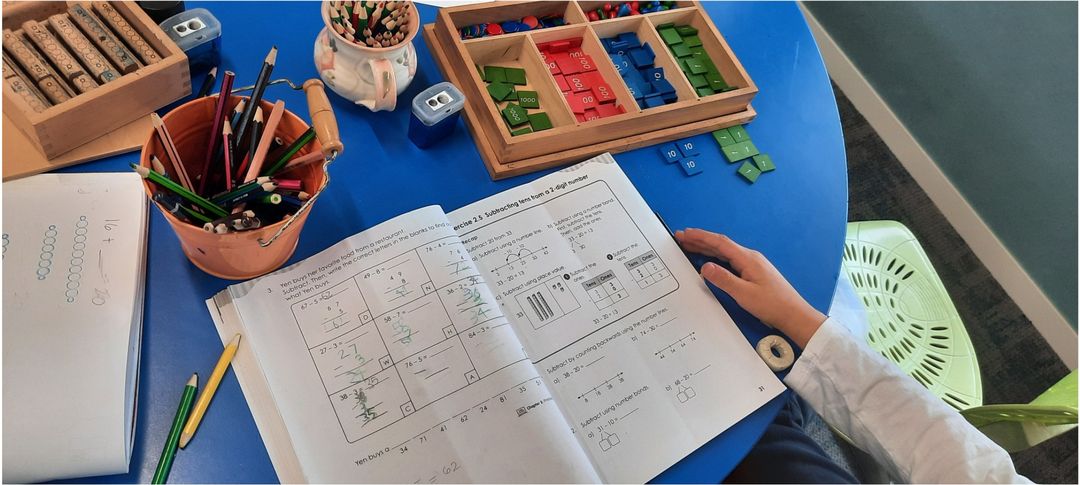
The Montessori Cosmic Curriculum offers children a big-picture understanding of the universe and their place within it. Through storytelling, timelines, hands-on materials, and impressionistic charts—known as the “keys to the universe”—children explore vast ideas across all subject areas.
It nurtures imagination, a sense of wonder, and an awareness that while humans are a small part of the universe, we carry great power and responsibility to contribute meaningfully to the world.
History
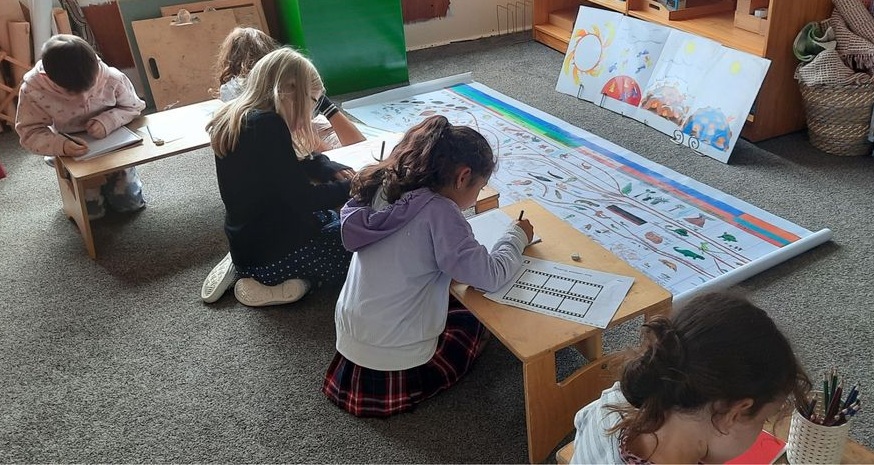
In our Montessori 6–12 classroom, history plays a big role in the Cosmic Curriculum. Every subject area, even math, is introduced through stories about its history, helping children see how everything is interconnected. We begin with the story of the earth itself, giving the tamariki a sense of how short human history is compared to the age of our planet. We use materials like the Black Strip, a 30-metre timeline with a tiny 1cm red line representing all of human history to give children a powerful sense of perspective. Students explore how early humans used their hands to create, use tools and build civilisations long before writing existed, deepening their understanding of both recorded and unrecorded history. Through timelines, stories, and group projects, children engage with the past in meaningful and exciting ways.
Biology
Biology in the Montessori classroom is not just about learning facts—it’s about cultivating wonder, observation, and responsibility. Children study plants and animals in connection to their function, needs, and adaptations. They build classification skills and refine scientific observation, often through Going Out experiences. Through storytelling and direct interaction with life, children begin to understand the interdependence of all living things, and with it, their own responsibility to protect and care for the natural world.
Geography/Physical Science
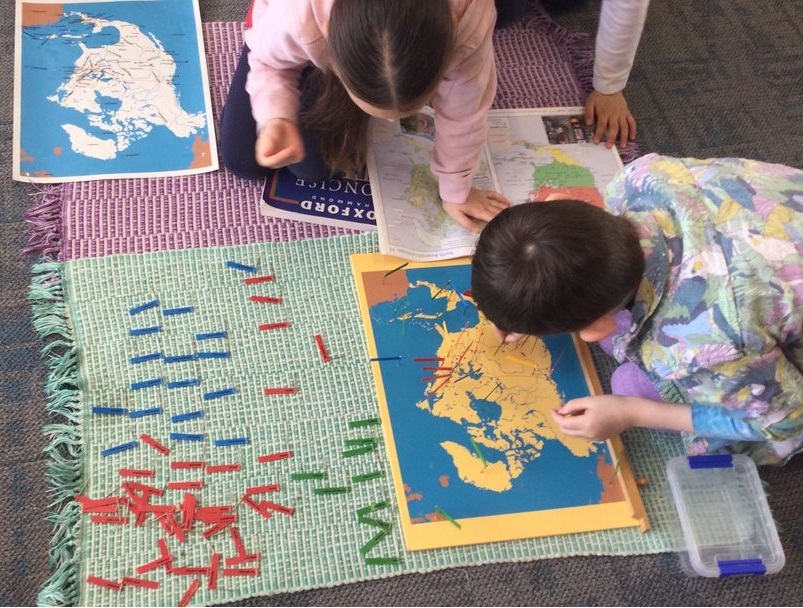
Geography is much more than just learning place names—it’s about understanding the Earth as part of a bigger story. The curriculum is organized around six main themes:
God with No Hand and the Creation of the Universe
Nature of Elements
Sun and Earth
Work of Air
Work of Water
Interdependencies and Economic Geography
We have a mini science laboratory offering a range of hands-on lessons and experiments to illustrate these topics. We also use impressionistic charts that help children imagine and understand big ideas without being overwhelmed by the details.
Mathematics
Montessori math helps children learn how to think, not just memorise. Through a hands-on, systematic approach, even complex concepts like square numbers or binomials can be introduced much earlier than in theregular classroom.
We use colour-coded, tactile materials, consistent with what was introduced in the Montessori preschool, to build a strong foundation in place value, operations, and number sense. These materials support children as they move confidently from concrete exploration to pictorial representation, and finally to abstract understanding.
Math is introduced through the Story of Number, helping children see mathematics as an integral part of daily life, a human invention created to measure, trade, solve problems, and make sense of the world.
Highlights:
Hands-on, colour-coded materials
Clear scope and sequence from basic to advanced
Higher-level concepts taught at a younger age
Emphasis on logic, reasoning, and problem-solving
Montessori nurtures the child’s natural “mathematical mind” through joyful exploration.
Geometry (offered as a distinct strand)
Geometry—meaning “to measure the Earth”—begins with the story of how ancient Egyptian harpedonaptae measured land to restore farmers’ fields after the Nile’s floods. Like all Montessori subjects, it starts with a story to spark curiosity and provide meaningful context.
In Montessori, geometry is treated as a subject in its own right, separate from general mathematics, due to the depth and hands-on exploration it offers. Even at age six, children can name and construct types of angles and explore concepts often reserved for much older students in a mainstream setting.
The geometry curriculum includes:
Lines and Angles
Polygons and The Circle
Area and Volume
Congruency, Similarity, and Equivalence
Language/Literacy
Literacy in a Montessori primary classroom is carefully structured and builds on the strong foundation laid in preschool. In the early years, children learn the sounds of letters and simple blends, while also being introduced to the function of words. In the primary years, this learning continues with a focus on phonemic awareness, spelling patterns, and rules, alongside a rich and engaging grammar curriculum.
Children use Montessori grammar boxes—colour-coded materials that guide them through the parts of speech, beginning with the noun family (noun, article, adjective), then expanding to verbs, prepositions, adverbs, pronouns, conjunctions, and interjections. Each word is explored through movement and symbol work to reinforce meaning and function.
Alongside this, students are taught to analyse sentence structure through a process called logical analysis, where they break down and understand the components of simple, compound, and complex sentences. This deepens their comprehension and strengthens both oral and written communication.
What sets Montessori literacy apart is how we teach grammar in a hands-on, discovery-based way. Students manipulate word cards, use physical grammar symbols, and engage in discussions that connect language to everyday use. This helps them see how words work, not just what they are.
Literacy Chapters We Explore:
Word Study and Spelling Rules
Grammar and Parts of Speech (via Grammar Boxes)
Sentence Analysis (Logical Analysis)
Reading Comprehension and Literature
Writing Process and Composition
Oral Language and Vocabulary Development
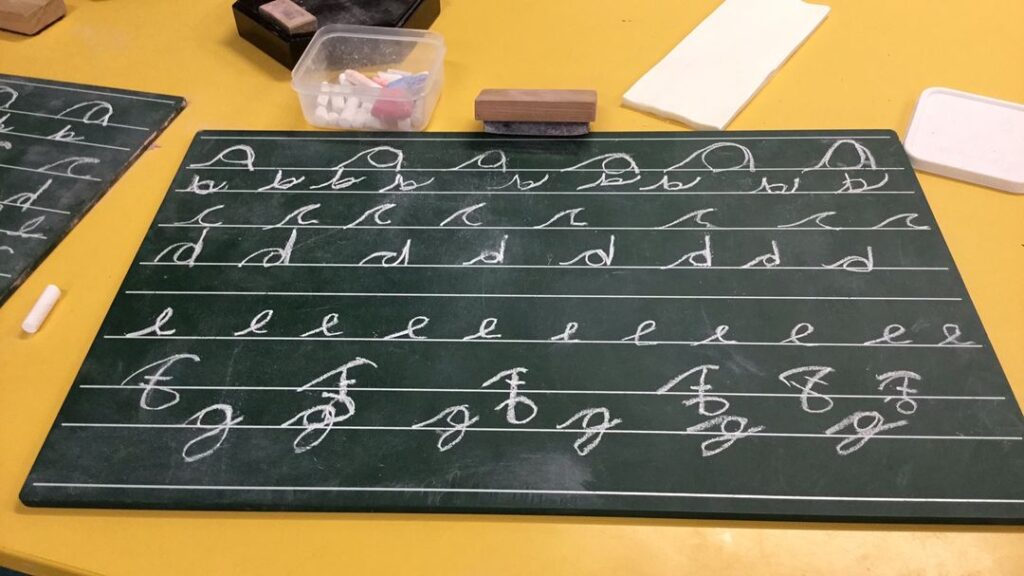
You’ll often see grammar symbols in your child’s writing books—they\’re learning to identify and use each part of speech meaningfully. We encourage you to ask them what each symbol means, and even play with language at home to support vocabulary growth.
Music and the Arts
In a Montessori 6–12 classroom, art and music are not add-ons—they are deeply integrated into the curriculum. Children don’t just “do art” or “have music”—they use these forms of expression in every area of learning. A child might illustrate a story about the origins of life, compose a song about prime numbers, or design a sculpture inspired by geometry. These creative choices are part of their daily work, not separate from it.
Art begins with observation. Children are introduced to the elements of visual art—line, texture, colour, shape, space, perspective, and value—through hands-on experiences. They learn to really see the world around them and develop technical skills to express what they observe. The prepared environment includes rotating art, natural materials, and student-made displays that support aesthetic development and personal expression.
Music is treated as a universal language. Children learn to listen with care, read and write musical notation, and explore rhythm, melody, and musical form. We build on the foundations laid in early years using Montessori music materials like bells and staff boards. Just like in language or maths, children move from experience to symbol, and from imitation to innovation.
As Dr. Montessori said, “Every child is an artist.” Our role is to provide the tools, time, and trust for them to explore and create across disciplines.
Highlights:
Art and music are fully integrated across the curriculum
Children express learning visually or musically (e.g., writing songs about math or painting historical timelines)
Emphasis on observation, creative choice, and problem-solving
Elements of art taught systematically, just like reading or maths
Music treated as a second language—read, written, heard, and created
Beautifully prepared environment that inspires creativity
Focus on self-expression, not performance or perfection
Te Reo Maori
Tamariki will engage with Māori language and culture as part of our learning, helping them to understand and respect it.
Social Skills Curriculum and the Virtues Project
These areas are interwoven through the Cosmic framework to help children discover patterns, meaning, and their own sense of purpose. This sets the stage for the Five Great Lessons, which launch deep exploration and lifelong learning.
Going Out
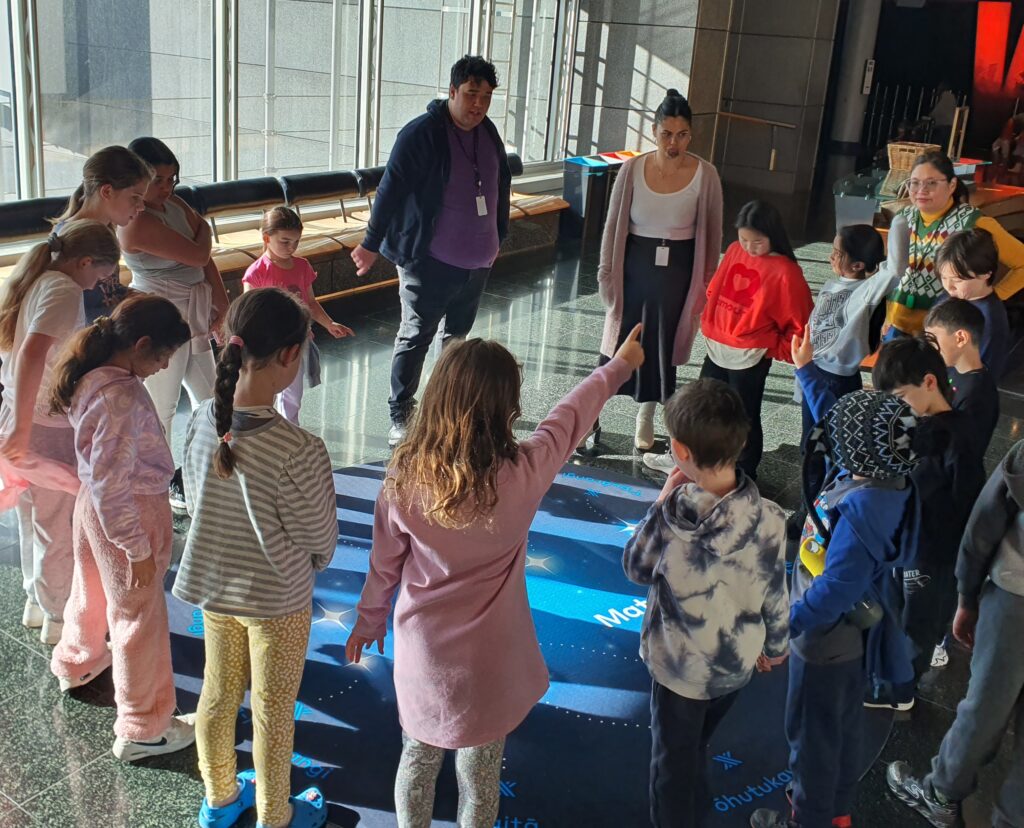
Going Out is an important part of Montessori education for the 6–12 age group, where small groups of tamariki plan and carry-out real-world trips with minimal adult help, developing their independence, responsibility, and real-life skills. These experiences extend their classroom learning into the wider community, giving them a chance to build relationships with people outside school. These trips might include visiting local libraries, museums, doing social work, or meeting community helpers as part of their research project.
Our class cooking program plays a key role in the Going Out aspect of the curriculum, where the tamariki learn to plan, budget, shop, cook, and serve others. Although it’s currently on pause, due to school renovations, we’re hoping to do one or two cooking activities. I’ll keep you posted if we need parent helpers for this.
How Montessori Aligns with the Refreshed NZ Curriculum
Montessori education adheres to a standardized international curriculum delivered by trained Montessori educators. Our curriculum provides a clear scope and sequence, starting from the preschool level (ages 3-6) and maintaining consistency through to the primary classroom. This systematic and structured approach has been in place even before the government adopted its current structured literacy and math strategies.
Montessori 5 Great Stories
At the heart of the Montessori 6–12 curriculum are the Five Great Lessons—a series of impressionistic, story-based presentations that ignite curiosity and provide a unifying framework for all areas of study. These stories are grand, inspiring, and designed to speak to the child’s imagination and thirst for understanding the world and their place in it.
The Story of the Creation of the Earth This first Great Lesson introduces children to the origins of the universe, the formation of the Earth, and the laws of nature. It lays the groundwork for the study of astronomy, physics, chemistry, geology, and the natural sciences. Children are drawn into big questions and timeless wonder: How did it all begin? What forces shaped our world?
The Coming of Life This story tells of the emergence of life on Earth, from the earliest organisms to the appearance of complex plants and animals. It leads naturally into the study of biology, botany, zoology, ecology, and the timeline of life. Children explore classification, habitats, and the interconnectedness of living things.
The Coming of Human Beings The third story focuses on what makes humans unique—our ability to think, create, love, and remember. This lesson sparks deep interest in early civilizations, history, geography, inventions, culture, and moral development. It introduces the idea that with our gifts came responsibility—to each other and to the planet.
The Story of Language This lesson tells of humanity’s need to communicate, from early symbols to spoken and written language. It opens the door to grammar, literature, writing, reading, research skills, and foreign languages. Children explore how language has evolved and how it reflects the culture and thinking of people across time and place.
The Story of Number The final story traces the development of mathematics as a tool humans created to measure, trade, solve problems, and understand the world. It forms the basis for the study of arithmetic, geometry, algebra, and applied mathematics. Children come to see math not just as a subject but as a language of precision and possibility.
These Great Lessons are more than just stories—they are gateways to deep exploration across the curriculum. They allow children to make connections between disciplines, pursue personal interests, and see themselves as part of a much larger story. With the guidance of the teacher, children follow their curiosity, work independently or collaboratively, and develop both academic skills and a deep sense of purpose.
“Education is a natural process carried out by the child and is not acquired by listening to words but by experiences in the environment.”