
About Montessori
What is Montessori?
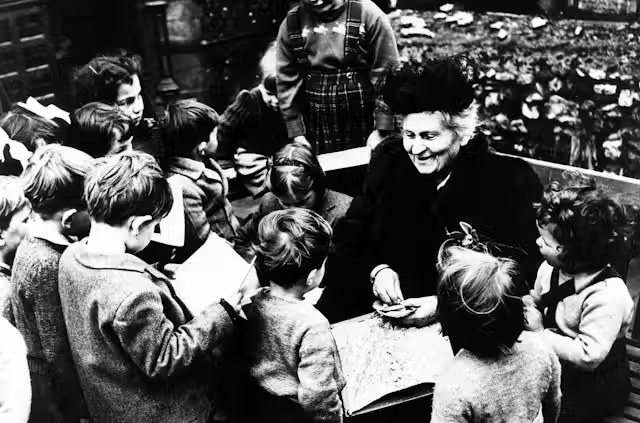
The word Montessori comes from the name of Dr. Maria Montessori.
“The child is both a hope and a promise for mankind.”
Maria Montessori
Maria Montessori was a woman ahead of her time—a pioneer, a scientist, and a strong advocate for children. A feminist in an era when women were not allowed to study certain subjects, she fought discrimination and became Italy’s first female doctor.
Her scientific background deeply influenced her approach to education. Long before the term “evidence-based practice” existed, she spent over four decades observing children and developing a research-based method that supported all learners—including those once labelled “uneducable.”
Working with children from all backgrounds, including those with disabilities and those living in poverty, Montessori developed an approach built on respect for the child, freedom within limits, and learning through meaningful activity. She saw that children thrive when they are given the freedom to explore and follow their interests, supported by adults who understand their developmental needs. Her method nurtures not just academic progress, but also independence, self-discipline, empathy, and peace.
Montessori’s approach has truly stood the test of time. It follows a global curriculum, implemented in over 22,000 schools across 170 countries, and remains as relevant today as ever. It recognises that when children develop a meaningful degree of independence, they set a pattern for a lifetime of good work habits, self-discipline, and a sense of responsibility.
At Manaaki Montessori, based at Tawa School, we are proud to carry on her vision—seeing education as more than instruction, but as a tool for social change, personal growth, and lifelong learning.
Principles of Montessori Education
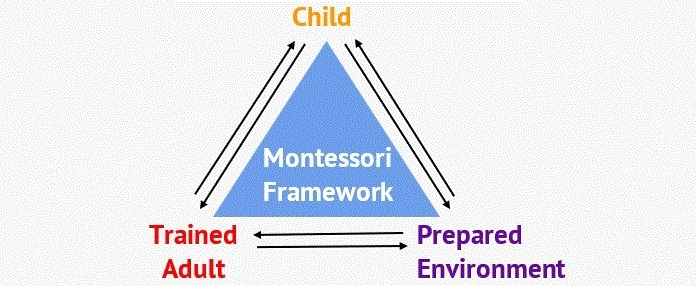
This triangle shows the three core elements of Montessori education: the Child, the Prepared Environment, and the Trained Adult/ Teacher. Together, they form the foundation for learning guided by Montessori Principles.
The Child
At the heart of Montessori education is the child. Each child is seen as capable, curious, and driven to grow. In the 6–12 years, they develop a reasoning mind, a strong sense of justice, and a deep need to belong. Montessori classrooms support this by offering freedom with responsibility—children choose their work within clear boundaries, allowing for self-direction and personal growth. The children in a Montessori class form a community of learners, where younger and older students work together in multi-age groupings that foster leadership, collaboration, and social development.
The Benefits of a Multi‑Age Montessori Classroom
One of the defining features of a Montessori classroom is its multi-age structure, typically spanning three years: 6–9 years (Lower Primary) and 9–12 years (Upper Primary). At Manaaki Montessori, we offer a combined 6–12 class, which provides an even richer learning environment, reflecting how real communities function and fostering strong, connected relationships within the classroom.
There are so many benefits of being in a multi-age classroom:
A Mini Practice Society
Our classroom functions like a small society, where children of different ages, backgrounds, and cultures learn and work together. This diversity fosters empathy, tolerance, and a strong sense of belonging. In this environment, social learning is valued alongside academic growth, and children build lasting relationships as they learn to collaborate and take responsibility for their shared space.
Tuakana–Teina and Peer Leadership
Mixed-age learning naturally fosters tuakana–teina relationships, where older students guide and support younger ones. These moments of peer mentoring and role modelling build leadership and confidence, while offering encouragement and inspiration to younger tamariki. Research shows that peer mentoring benefits both mentor and mentee – socially, emotionally, and academically, as knowledge and responsibility are shared.
Supportive and Self-Paced Learning
Tamariki are free to move at their own pace, revisiting concepts or moving ahead when ready. Children working at more advanced levels can be challenged academically while still enjoying social connection with their same-age peers. Likewise, those needing more time feel supported and included, not left behind. Without the pressure of competition, learners feel safe to take risks, make mistakes, and support one another. This creates a calm, respectful atmosphere where collaboration replaces comparison, and every learner is celebrated for their unique progress.
In a Montessori class, children learn not just from the adult but from each other. This shared knowledge creates a collaborative learning culture where everyone contributes.
The Prepared Environment
The Montessori environment plays a key role in developing the child’s independence, curiosity, and focus. It is a purpose-built space that allows for movement, a variety of work, and opportunities for “great work”—large, meaningful projects that emerge from the child’s interests.
Beautiful, child-sized materials, designed by Dr. Maria Montessori, are arranged on open shelves in a clear, sequential order—not only to support the child’s internal sense of order, but to reflect the scope and sequence of the curriculum itself. The entire curriculum is physically laid out in the environment, allowing students to choose freely from purposeful work while progressing through increasingly complex concepts.
For children aged 6–12, the environment expands beyond the classroom. Real-life experiences, such as our cooking programme and Going Out activities, offer further opportunities to apply learning in meaningful, practical ways.
Uninterrupted Work Cycle *
A cornerstone of the Montessori classroom is the uninterrupted work cycle—a long, focused period where children can fully immerse themselves in purposeful activity. This supports Mihaly Csikszentmihalyi’s Flow theory, where learners experience deep concentration, joy, and a natural sense of progress.
These extended work periods also build self-regulation skills, helping children learn how to manage their time, make choices, and take breaks when needed—just as adults do in real life.
The Trained Adult
In a Montessori classroom, the adult is not just a teacher, but a guide—carefully trained to connect the child with their environment. Through specialised Montessori training, the adult learns how to use each material, how to follow the clear scope and sequence of the curriculum, and—most importantly—how to observe the child.
The adult’s role is to model the use of materials, then step back to allow the child time and space to explore. We act as a link between the child and the environment, responding thoughtfully to their needs and interests.
“The greatest sign of success for a teacher… is to be able to say, ‘The children are now working as if I did not exist.”
Maria Montessori
Observation is central to our work. Montessori adults spend hours in training observing children, learning to recognise human tendencies, developmental stages, and learning patterns. Like scientists, we gather data through careful observation, listen deeply, and use this insight to guide each child’s next step.
When a child struggles to make responsible choices, we gently guide them back. Freedom is always balanced with responsibility. Children are offered choices within clear boundaries, with the level of freedom adjusted according to their growing sense of responsibility. Through learning conversations, we help children develop self-regulation, reflect on their decisions, and learn to make wise, independent choices.
Montessori Planes of Development
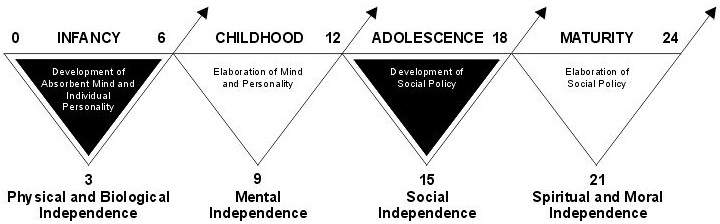
Maria Montessori identified Four Planes of Development, each representing a unique stage in a child’s growth with distinct physical, cognitive, emotional, and social characteristics. These planes guide educators and parents in supporting the child’s natural development.
The 6-12 year plane, often called the “Second Plane,” is a time of extraordinary intellectual curiosity and moral development. Children in this stage develop a deep desire to understand the world beyond themselves — exploring history, geography, science, and culture. Their imagination and reasoning skills blossom, enabling them to connect abstract ideas and seek justice and fairness. During these years, children thrive in a prepared environment that encourages exploration, collaborative work, and the development of empathy, creativity, and self-discipline. Supporting self-regulation and independence is key, as children begin to build their own inner moral compass and social awareness. The curriculum we follow in Room 9 is specifically designed to support the unique characteristics and developmental needs of the child in the Second Plane of Development.
Montessori vs Manstream Education
Every child is unique, with different learning styles, interests, and needs. Both Montessori and mainstream education offer valuable experiences and can support children in meaningful ways. This comparison is not about which method is better, but rather about highlighting the distinct features of each approach—so families can make informed choices that best suit their child.
Here’s a side-by-side look at how Montessori education (as practiced at Manaaki Montessori) compares to mainstream schooling, focusing on the 6–12 age group:
| Montessori Education | Mainstream Education |
Individualised Instruction: Lessons are given in small gorups, tailored to student’s ability and interests. There is more room to explore topics and choose their work from a range of lessons presented by their teacher. Mixed-age classrooms: Children aged 6 -9 , 9 -12 or 6-12 learn together, encouraging peer mentoring and social development. Systematically Designed Montessori Materials: An extensive collection of hands-on materials in every subject area guides students from concrete experiences to abstract understanding. These materials span all levels, from preschool through to concepts introduced at college level. Focus on deep concentration: Extended uninterrupted work cycles (usually 2–3 hours) foster deep concentration and self-regulation. Interdisciplinary but Integrated Curriculum: Big-picture themes (Cosmic Education) connect subjects, weaving history, geography, science, music, and the arts into literacy and numeracy learning. Teacher as guide: The teacher connects students to materials by directly modeling the lesson and co-constructing learning with them. Students have plenty of choice in how to complete follow-up work, giving them more opportunity to lead their own learning, develop self-regulation skills, and build intrinsic motivation. Learning through real-world experiences: Activities like going out, cooking, community projects are embedded in the curriculum. There is astorng focus on developing the whole child | Teacher-directed learning: Curriculum is largely determined and paced by the teacher. Learning is mostly delivered to the whole class at the same pace, with limited opportunities for differentiation or tailoring lessons to each child’s individual needs. Single-age classrooms: Students are grouped by age and expected to progress uniformly. Limited opportunity for tuakana-teina within the classroom. Traditional resources: Students are increasingly using hands-on materials to support learning at all levels, but resources are often limited, so textbooks, worksheets are extensively used. Segmented lessons: The school day is broken into three 1.5 hour blocks.Frequent transitions between subjects can interrupt focus. Subjects taught separately: Math, literacy, science, etc., are taught in distinct blocks. Teacher as instructor: Direct teaching and classroom management are central. Teachers often use extrinsic motivation, such as rewards, stickers, or incentives to encourage participation and achievement, Learning through set curriculum: Bookwork dominates, with fewer opportunities for hands-on, real-life learning experience |